
Uterine fibroids
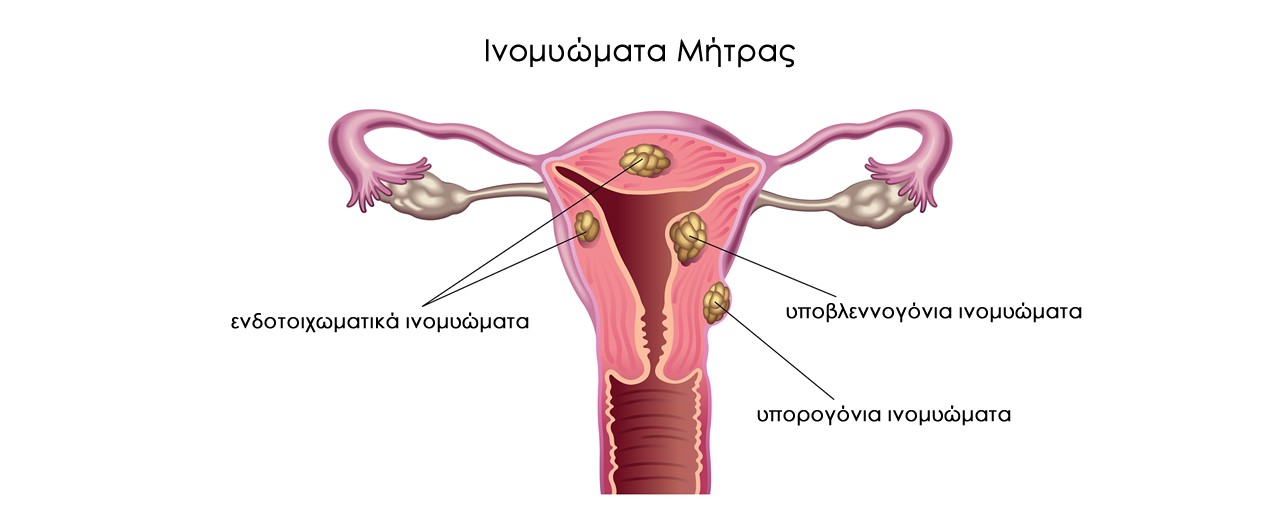
(Information for the public according to the Royal College of Obstetricians and Gynaecologists) – for more information, women should consult their gynaecologist.
Uterine fibroids are benign (non-cancerous) tumours of the uterus. They are the most common tumours that develop in a woman’s pelvis. They occur in about 20–25% of all women. Many women do not know they have fibroids, as they are often small and cause no symptoms. Fibroids can cause problems depending on their size, location, or number. Like all tumours, they should be evaluated by a doctor.
This information leaflet will explain:
- The different types of fibroids
- Their symptoms
- How they are diagnosed and treated
Types of fibroids
Fibroids are tumours that develop from the muscle cells forming the wall of the uterus (the myometrium). They are also called leiomyomas or simply myomas.
The size, shape, and position of fibroids vary greatly. They can be located inside the uterus, on its outer surface, within the uterine wall, or attached to it by a thin stalk.
Fibroids may range from small pea-sized nodules to large spherical masses exceeding 10 cm in diameter. As they grow, they may compress both the inner and outer surfaces of the uterus. Sometimes fibroids become so large that they fill the entire pelvis or, rarely, the whole abdomen.
A woman may have a single fibroid or many of varying sizes. It is difficult to predict whether they will appear singly or in groups. They may remain small for a long time, increase rapidly, or grow slowly over several years. Because their growth is unpredictable, treatment decisions can be challenging.
Causes
Fibroids are more common in women aged 30–40, but they may also appear later in life. They are more frequent among Black women than white women and tend to occur at younger ages and grow more rapidly in this group.
Although fibroids are very common, little is known about their exact cause. The female hormone oestrogen seems to promote their growth. Oestrogen levels naturally fluctuate — for example, they rise during pregnancy and fall after menopause. Certain medications can also affect oestrogen levels.
Symptoms
Most fibroids, even large ones, cause no symptoms. When symptoms occur, they may include:
- Changes in menstrual periods
- Heavier bleeding
- Longer or more frequent periods
- Menstrual cramps
- Vaginal bleeding between periods
- Anaemia (from blood loss)
- Pain
- In the abdomen or lower back (often dull, sometimes sharp)
- During sexual intercourse
- Pressure symptoms
- Difficulty or frequency in urination
- Constipation, rectal pain, or bowel movement difficulties
- Abdominal cramps
- Miscarriage and infertility
These symptoms can also be caused by other conditions. Therefore, you should see your doctor if you experience any of the above.
Diagnosis
During a routine gynaecological examination, fibroids may first be suspected. There are several tests that can provide more information:
Ultrasound scans use sound waves to create an image of the uterus and pelvic organs.
Hysteroscopy uses a thin instrument (the hysteroscope) that allows the doctor to view the inside of the uterus through the vagina and cervix, detecting fibroids inside the uterine cavity.
Hysterosalpingography is an X-ray test that can reveal abnormalities in the size and shape of the uterus and fallopian tubes.
Laparoscopy uses a thin telescope-like instrument (the laparoscope) inserted through a small incision below the navel to view the uterus and surrounding structures. It can reveal fibroids on the outer surface or within the uterine wall.
Other imaging techniques, such as CT or MRI scans, may be used but are rarely necessary. Fibroids are sometimes found incidentally when these or other tests are performed for unrelated reasons. Some of these tests may also be used to monitor fibroid growth over time.
Complications
Although most fibroids cause no problems, complications can occur. Fibroids attached by a stalk may twist, causing pain, nausea, or fever. Fibroids can occasionally become infected, usually when an infection is already present in the pelvic area. Very rarely, rapid fibroid growth may indicate cancer.
Large fibroids can enlarge the abdomen, making pelvic examination more difficult.
Fibroids may contribute to infertility. Other causes should be ruled out before assuming fibroids are responsible. If fibroids are determined to be the cause, many women can conceive after treatment.
Treatment
Fibroids that cause no symptoms, are small, or occur in women approaching menopause often require no treatment.
However, treatment may be needed if you experience:
- Severe pain or heavy bleeding during periods
- Bleeding between periods
- Uncertainty whether the mass is a fibroid or another tumour (e.g., ovarian tumour)
- Rapid increase in fibroid size
- Infertility
- Pelvic pain
If you have fibroids or have had them in the past, you should have regular medical check-ups. If you develop symptoms, see your doctor promptly. There is no reason to avoid sexual intercourse unless it causes pain.
Fibroids can be treated surgically. Medications such as GnRH analogues may be used temporarily to shrink fibroids and control bleeding, often to prepare for surgery.
Fibroids can be removed by myomectomy or hysterectomy. The choice of treatment depends on your preferences, and the medical assessment of fibroid size and location.
Myomectomy
Myomectomy is the surgical removal of fibroids while preserving the uterus. Because the uterus remains intact, the woman may still be able to conceive. If pregnancy occurs after a myomectomy, a Caesarean section may be required. However, sometimes internal scarring of the uterus may lead to infertility.
Fibroids may regrow even after surgery, and a repeat operation may be necessary in 20–40% of cases.
Myomectomy can be performed in several ways:
- Laparotomy
- Laparoscopy
- Hysteroscopy
The choice depends on the size and location of the fibroids. During a laparotomy, an incision is made in the abdomen and the fibroids are removed through it. Fibroids can also be removed using a laparoscope, inserted to view the inside of the abdomen.
A hysteroscope can remove fibroids that project into the uterine cavity. This can be done using a resectoscope, a thin wire loop that uses electrical current. These instruments pass through the hysteroscope. While this method cannot remove deeply embedded fibroids, it usually controls the bleeding they cause. This type of treatment often does not require a hospital stay.
Hysterectomy
Hysterectomy is the surgical removal of the uterus. The ovaries may or may not be removed, depending on individual factors. Hysterectomy may be recommended if:
• Pain or bleeding persists
• Fibroids are very large
• Other treatments are not possible
• The woman does not wish to have more children
If your doctor recommends a hysterectomy, other uterine problems such as endometrial disease should first be ruled out.
Fibroids and pregnancy
A small number of pregnant women have fibroids. If you are pregnant and have fibroids, they usually do not cause problems for you or your baby.
During pregnancy, fibroids may grow larger due to increased blood flow and hormonal changes. This can cause discomfort, pressure, or pain. In most cases, fibroids shrink again after childbirth.
Fibroids may increase the risk of:
- Miscarriage (loss of pregnancy before 20 weeks)
- Preterm birth
- Breech position (baby not head-down)
Rarely, a large fibroid may block the cervix or birth canal, requiring a Caesarean section. In most cases, however, even large fibroids move out of the way as the uterus expands during pregnancy. Women with large fibroids may experience heavier bleeding after delivery (uterine atony).
Usually, no treatment is required for fibroids during pregnancy. If you experience pain or discomfort, your doctor may recommend rest. Occasionally, a pregnant woman with fibroids may need hospital care for bleeding, pain, or threatened preterm labour. Very rarely, a myomectomy may be performed during pregnancy, followed by a Caesarean section for delivery.
In conclusion…
Uterine fibroids are benign tumours that occur very commonly in women. Around one in four or five women over the age of 35 have fibroids. They often cause no symptoms and therefore require no treatment.
If you have fibroids or have had them before, you should be monitored regularly by your doctor.

Dr. Lambros Babatsias
Consultant Obstetrician & Gynaecologist
Trained in London in Laparoscopy and Hysteroscopy (University Dept. of Obstetrics and Gynaecology – Royal Free Hospital – London)
--------------------
See all our blog articles by clicking here.
0 comment(s)