
How to interpret pregnancy tests

How Pregnancy Is Confirmed
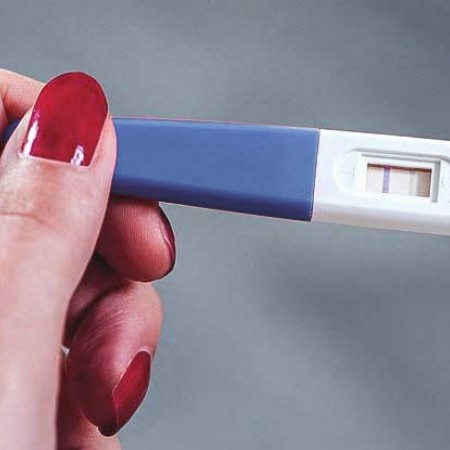
hCG (Human Chorionic Gonadotropin) is a hormone produced by the placenta in the early stages of pregnancy and throughout its duration. This is the hormone that pregnancy tests detect in urine, confirming pregnancy. hCG does not appear in urine immediately after fertilization—it is secreted only when the fertilized egg implants in the uterine wall. At least 8–9 days must pass before the hormone can be detected in urine, which is the time it takes for the fertilized egg to travel from the fallopian tube to the uterus. From that moment, hCG production begins, and in early pregnancy it doubles every 2–3 days, which is a sign that the pregnancy is progressing normally. When hCG levels reach about 15 mIU/ml (in urine), you will see a very faint test line on our pregnancy tests. As hCG levels increase, the test line darkens. When it reaches 25 mIU/ml, then both lines on the test will be equally strong (control line and test line). At that point, you can be almost certain that your pregnancy has successfully begun!
Click here to read our article on hCG levels during pregnancy and test sensitivity.
What Can Happen If You Test Too Early
In general, it’s wise not to rush! The earlier you take a pregnancy test, the more likely you are to get misleading results. Everything depends on the day of conception, the hCG levels present in the urine at that time, and the sensitivity of the test—meaning how early it can detect hCG.
Let’s look at three possible scenarios when taking your first pregnancy test a few days before your expected period, and when a pregnancy test can show positive results:
Scenario 1
You take a pregnancy test 4 days before your expected period and no test line appears. The test is negative, but you may still be pregnant, with hCG levels below 15 mIU/ml, which is why no result appears or the test line is very faint after some time. As long as your period hasn’t started, keep testing daily. If pregnancy exists, the test will soon show a line; if not, your period will begin shortly.
Scenario 2
You take a pregnancy test 4 days before your expected period and a very faint line appears in the result window—so faint that you wonder if it’s positive or not. If the test line is visible at all, yes—it’s positive, even if faint. However, it’s still very early! You should be cautiously optimistic, since while a pregnancy has started, it may also end at this stage (biochemical pregnancy—a fairly common event). In this case, hCG will not increase, and the test line on subsequent tests will fade away. If the second line becomes fainter compared to a previous test, unfortunately it’s likely a biochemical pregnancy.
Scenario 3
You take a pregnancy test 4 days before your expected period and a very faint test line appears. Keep testing over the next few days. For the first few days, the faint line will remain—that’s normal in the very early stages. Later, however, the test line should gradually become darker and clearer. The more the test line darkens, the more confident you can feel—and it’s time to schedule your first ultrasound appointment with your gynecologist.
In general, keep in mind that the presence of hCG itself is less important than its rate of increase.
At HomeTest, we always advise our customers to be patient and wait until the day of their expected period to take their first pregnancy test. It’s truly worth waiting those few extra days—you’ll get a much more reliable result and avoid the uncertainty of a faint positive line. If your cycles are irregular or you haven’t tracked ovulation using ovulation tests, start testing 15 days after the intercourse you believe led to conception.
Also note that in the first few days after a missed period, it’s normal for consecutive pregnancy tests to look similar, as early hCG levels rise slowly. After the 5th week of pregnancy, however, hCG nearly doubles every day! Specifically, if you know your ovulation day, count 18 days after it—by then, the test line should be clearly darker!
Finally, before using any pregnancy test, we strongly recommend that you read the instructions carefully, even if you think you already know them. They contain valuable information and helpful FAQs.
Good luck! 
--------------------
See all our blog articles by clicking here.
0 comment(s)